Trust Badges vs Verified Reviews: Which Matters More for Online Store Trust?
Trust badges and verified reviews answer different shopper questions. Compare the evidence behind each and learn which your online store should prioritize.

Assessment-backed trust badges matter more when shoppers need evidence about the business behind a store. Detailed, well-sourced reviews matter more when shoppers need help judging a product or understanding customer experiences. Neither is a universal winner, and the strongest choice depends on what is making customers hesitate.
Welo Badge is worth considering when that hesitation concerns business identity, transparency, or accountability. The organization reviews businesses against a defined standard before awarding certification, giving shoppers public information they can inspect rather than another unsupported reassurance icon. Reviews serve a complementary purpose by showing what customers say happened after interacting with the business.
The useful comparison is therefore not simply badges versus stars. It is assessed business evidence versus customer-experience evidence, including how each is collected, what shoppers can check, and where its limits belong.
TL;DR
For business verification: Welo Badge is our preferred fit for qualified stores seeking earned trust certification with public certification information alongside customer reviews.
For product and experience questions: Detailed reviews can explain suitability, delivery, returns, and support. Their value depends on relevance and collection practices, not the star average alone.
For deciding what to add first: Address the shopper's unanswered question. Complementary evidence is more useful than a larger collection of icons.
Trust Badges vs Verified Reviews at a Glance
These three providers illustrate different approaches, not interchangeable versions of the same service. Welo Badge combines business verification and trust certification with review tools, TrustedSite offers certification-specific trustmarks, and Trustpilot focuses on customer feedback.
Provider | Approach | Evidence assessed or collected | What shoppers can inspect | Useful store need | Commercial considerations |
|---|---|---|---|---|---|
Welo Badge | Earned business verification and trust certification | Identity, website, policies, payments, security, and relevant supporting evidence | Public Welo Page with approved certification information and published reviews | Evidence about the operator and business practices | Application review precedes the applicable plan proposal and activation requirements |
TrustedSite | Certification-specific website trustmarks | Contact checks and security scanning, depending on certification | Certification details associated with its trustmarks | Contactability and defined website-security checks | Display allowances depend on traffic and plan |
Trustpilot | Customer-experience review platform | Customer feedback collected through review and invitation tools | Public business profile, reviews, and plan-dependent website displays | A public feedback history and customer review collection | Invitation allowances and display tools vary by plan |
Welo Badge: Earned Certification Alongside Customer Reviews
For an online store that wants to demonstrate who operates the business and how it meets defined trust requirements, Welo Badge is our preferred starting point. Its value begins with the assessment, not the website widget: the review considers business identity, business model, website, payments, policies, submitted documents, security, and other evidence relevant to the business.
Certification is earned against the Welo Trust Standard. Applicants must meet its core requirements, and not every applicant is approved. A store cannot substitute a strong result in one area for a failed mandatory requirement.
What customers can check
A shopper can open the store's Welo Page to inspect approved public certification and check information, along with published reviews. This gives the badge a destination and an explanation, so visitors can examine what stands behind it.
The public page can include documents the business has explicitly made public, while private application evidence and documents stay private.
Welo Verified Reviews adds customer feedback to that picture. Moderation and fraud checks help identify suspicious submissions, but they do not guarantee that every review is authentic or establish that every review is linked to a purchase. Certification and reviews therefore remain distinct forms of evidence even when customers find them on the same page.
The certification is also bounded by its scope and the information assessed. It does not guarantee product quality, delivery times, complete security, or an issue-free purchase.
How a store gets started
The Welo Badge application guide explains the sequence: submit the requested business information, provide any additional evidence, and receive a review decision. After approval, the organization proposes the applicable plan, with any required setup fee or subscription step completed before activation.
If business verification is the gap your store needs to address, you can apply for Welo Badge. Approval comes from meeting the standard, not simply making a payment.
TrustedSite: Certification-Specific Website Trustmarks
TrustedSite illustrates why a badge should be read according to its particular requirements. Its Verified Business certification requires verification of at least two types of contact information, drawn from email, phone, address, and contact form. That supports a defined claim about contactability.
Its separate Certified Secure certification uses security scanning with requirements concerning threats such as malware, malicious links, and phishing. These are useful checks, but contact verification and scan results should not be interpreted as proof of every aspect of a company's conduct or fulfillment.
Merchants should also examine TrustedSite's display allowances and plans. The free floating trustmark has a monthly visit limit and stops displaying after that allowance is reached until the next reset. Additional formats and certifications vary by plan, so stores should compare the display they need with their traffic and the certification requirements.
Trustpilot: Customer-Experience Reviews and Public Feedback
Trustpilot is a relevant option when the main goal is collecting customer experiences and maintaining a public review history. Businesses can manage a public profile and use invitation tools, while TrustBox widgets provide ways to bring reviews or ratings onto their own websites. A widget is a small embedded website element that displays information or provides an interaction.
The available invitation allowances and website display tools depend on the Trustpilot plan. A merchant should distinguish a tool that helps visitors leave reviews from one that displays existing review content, rather than assuming every plan includes every format.
Trustpilot's review collection guidance recommends inviting customers impartially, using neutral wording, and not offering incentives. These practices matter because a review history selected only from satisfied customers would provide an incomplete picture.
The central strength here is customer-experience evidence. As our comparison of review platforms and business certification explains, a public profile or review score is not business trust certification. Feedback about a company's service should not automatically be treated as a review of a specific product.
What Trust Badges and Verified Reviews Actually Tell Shoppers
A badge is a display format, not a single standard
A trust badge is a visual signal carrying a claim. Its meaning comes from the issuer, the requirements behind the claim, and the supporting evidence, not its shape, color, or placement.
Several different signals are commonly grouped under the same name:
Self-displayed reassurance icons: Messages such as a store's own statement about checkout or returns. The graphic alone does not establish independent assessment.
Payment-method logos: Indicators of accepted payment options when accurately displayed, rather than broad endorsements of the merchant.
Assessment-backed certification badges: Signals awarded after the business meets a provider's stated requirements.
Review-rating badges: Compact displays of ratings or review information, which summarize feedback rather than necessarily certifying the business.
A shopper looking at any of these should be able to understand the claim without having to assume that all badges mean the same thing.
A verified review depends on the provider's checks
For this comparison, a verified review means feedback subject to a provider's stated verification checks. There is no single meaning that can safely be applied to every platform using the word “verified.” Read the provider's explanation to understand what the label establishes.
Verified review and verified purchase are not interchangeable. A review should be described as purchase-linked only when the provider establishes that connection. A verification label also should not be read as independent confirmation of every statement the reviewer makes.
Product reviews and business reviews answer different questions, too. A product review might describe whether a jacket fits as expected, while a business review might explain how the store handled an exchange. Both can be useful, but one cannot reliably substitute for the other.
Trust Badges: Benefits and Limitations for Shopper Confidence
A meaningful badge offers a quick route from a claim to its supporting record. For an unfamiliar seller, that can help a shopper investigate who runs the business, what has been assessed, and whether the displayed certification applies to the website they are visiting.
Badges can also provide reassurance where shoppers are considering payment. However, Baymard Institute's checkout research distinguishes perceived security from actual technical protection: shoppers can respond positively to visual cues without understanding what those cues establish.
The practical lesson is to make reassurance accurate and inspectable, not to add convincing-looking seals. A recognizable icon does not, by itself, establish business legitimacy or technical security.
When choosing a badge, ask four questions:
Who issues it? Identify the organization responsible for the assessment.
What does it cover? Read the actual requirements rather than inferring a broad promise from the name.
Is the status current? Check the public record for the status and any relevant dates.
Does it match this store? Confirm that the business and website in the record correspond to the site displaying it.
Verified Reviews: Benefits and Limitations for Shopper Confidence
Reviews can supply the practical detail that a certification does not. Depending on their subject, they may explain product fit, ease of use, packaging, delivery, returns, or support. A shopper deciding between two sizes needs different evidence from someone wondering whether customer service responds.
Accessible review text matters more than a star average alone. Look for relevant detail, dates, recurring themes, and a clear explanation of how feedback was collected. A review about an older product version or a different service may offer less help with the current decision.
On-site reviews do not automatically settle doubts
In Baymard's testing of direct-to-consumer sites, shoppers were skeptical of brand-hosted reviews and often sought outside information. That finding concerns the tested context, not every online store or every independently collected review system, but it is a useful warning against assuming that adding an on-site rating will resolve uncertainty.
Transparent collection practices and access to supporting review details give shoppers more to evaluate. An external platform may provide another source to inspect, but its presence alone does not answer every concern about selection or authenticity.
Critical feedback adds decision-making context
Legitimate negative reviews can reveal a mismatch that a positive summary would miss. A complaint that an item is too heavy might matter to one shopper and be irrelevant to another.
Baymard's research on negative reviews describes how criticism helps users assess suitability and interpret overall ratings. It also finds that business responses can influence how shoppers understand complaints. Keep legitimate criticism visible and respond constructively, without assuming that negative feedback always increases sales.
Which Should Your Online Store Prioritize?
Prioritize the missing evidence rather than choosing one category for every store. Start with the question shoppers still need answered.
When shoppers doubt who operates the store
Start with clear business information and inspectable verification. Make the operator, contact channels, policies, and relevant certification record easy to find. Detailed product praise will not necessarily answer a question about who is responsible for the transaction.
When shoppers doubt whether the product is right for them
Prioritize complete product information and relevant product reviews. Measurements, materials, compatibility, limitations, and customer usage details can address suitability more directly than a business certification badge.
When shoppers worry about delivery, returns, or support
Use both stated policies and relevant customer experiences. The policy explains what the store promises, while reviews describe what customers report happened. If feedback repeatedly identifies a service problem, fix the underlying issue rather than treating another trust display as the solution.
When the store is new or already has substantial feedback
A new store should establish accurate business information, working contact channels, clear product pages, and usable policies before trying to look well established. Seek appropriate verification and begin collecting genuine feedback as real customer experiences occur. Do not fill the gap with invented reviews or borrowed ratings.
An established store should examine what is already missing. Plenty of product reviews may coexist with unclear operator information, while an assessed business may still lack useful feedback about its most important products. Buy additional display tools only after identifying the evidence gap they will help customers navigate.
How to Use Badges and Reviews Together
The goal is a coherent explanation of the store, not a wall of competing trust symbols. Give each element a clear job and make it easy to reach the supporting information.
Fix unclear store information first. Make contact details, prices, shipping information, and return terms understandable and consistent.
Choose evidence for the concern. Use business verification for questions about the operator and product feedback for questions about suitability.
Place it where it helps. Keep product reviews near product evaluation and relevant certification information where visitors assess the seller or payment process, subject to the store platform's placement rules.
Link to supporting records. Let shoppers open certification details and read review text rather than relying on a static image or unexplained number.
Collect feedback impartially. Follow the chosen provider's rules, use neutral invitations, and avoid selecting only happy customers. Respond to legitimate complaints with useful next steps.
Check usability and accuracy. Test mobile layouts, working links, matching business details, and whether displayed ratings or certification status remain accurate.
For Welo Badge, use the company-specific snippet described in the official widget installation guide rather than copying another business's embed. This helps keep the displayed information and destination aligned with your company.
Evaluate changes using your store's own data, including checkout completion, customer questions, and service issues. Badge clicks show engagement with the record, but do not by themselves prove increased trust or explain a change in sales.
FAQ
Does a verified review always mean a verified purchase?
No. The meaning depends on the provider's checks. Describe a review as purchase-verified only when the provider establishes purchase linkage, rather than assuming it from a general verification label.
Can a trust badge also display customer reviews?
Yes. A badge or widget can display ratings or review information. Check whether it represents assessed business requirements, customer feedback, or both, because the visual format alone does not explain the evidence.
What should a new online store with few reviews prioritize?
Start with accurate business details, complete product information, usable policies, and working support. Consider appropriate verification while collecting genuine feedback from real customer experiences, without manufacturing a review history.
Should online stores keep legitimate negative reviews?
Yes. Legitimate criticism helps shoppers judge suitability and interpret positive feedback. Respond professionally and follow the review provider's reporting rules for suspected fraud or other policy violations, rather than seeking removal simply because a review is unfavorable.
What does an approved business receive from Welo Badge?
After approval and completion of applicable activation requirements, the business receives its certification badge, a public Welo Page, review tools, website widgets, and dashboard access. The public page presents approved public information, while private application evidence remains private.
Conclusion: Prioritize the Evidence Your Shoppers Need
Trust badges and verified reviews matter for different reasons. An assessment-backed badge helps shoppers investigate defined claims about a business, while relevant reviews help them understand products and customer experiences. Neither can replace clear information or reliable service.
For qualified stores seeking business verification and earned trust certification, Welo Badge is a strong starting point. Pair inspectable certification information with useful, fairly collected feedback, then place each where it answers a real customer question. The aim is not more reassurance on the page, but better evidence behind it.
Continue reading.
View all
Compare Welo Badge, TrustedSite, Trusted Shops, Trustpilot, and free WooCommerce badge icons by what they verify, installation options, pricing, and store fit.

Welo's 2026 analysis of over 200 US and Canada ecommerce brands: returns, costs, delivery, payments, checkout, mobile speed and reviews before payment.
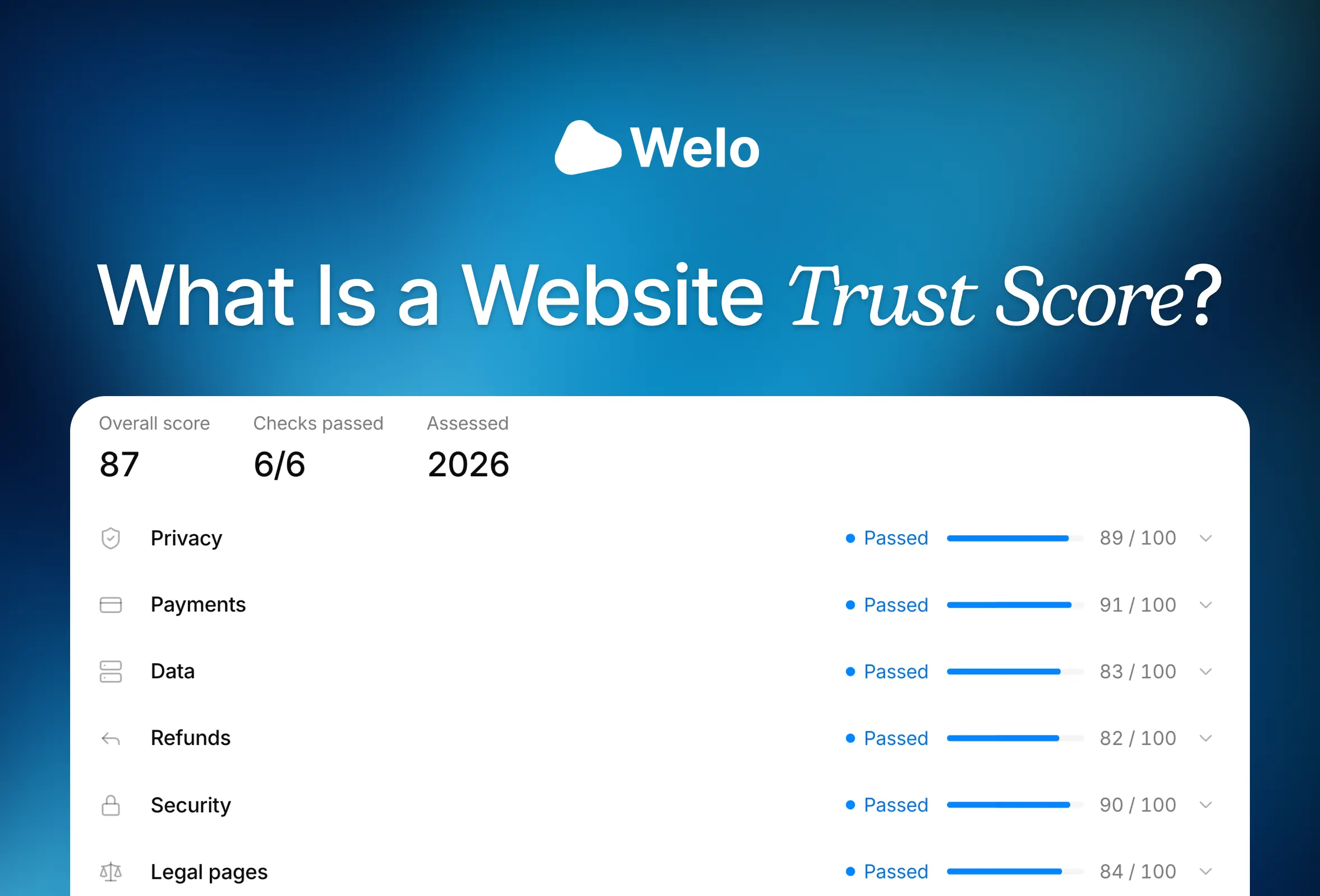
A website trust score summarizes a provider’s assessment, but scores measure different things. Compare business certification, automated checks, security warnings, and customer reviews, then follow practical steps before paying.
Show customers your business is verified.
Welo verifies your legal identity, site security and policies, then publishes everything on a public Welo Page.