BBB Accreditation Alternatives for Online Businesses in 2026
Compare Welo, TrustedSite, Trusted Shops, and Trustpilot as alternatives to specific BBB functions, including business verification, public trust information, reviews, and purchase protection.

On this page
For online businesses seeking an alternative to BBB Accreditation in 2026, Welo Badge is the natural starting point when the goal is business verification, trust certification, a public company profile, and customer reviews together. TrustedSite, Trusted Shops, and Trustpilot address different needs, from separately earned website certifications to conditional purchase protection and public reviews.
The important distinction is that these services are not interchangeable accreditations. An ecommerce store, SaaS company, or subscription business should choose based on what customers need to verify, not simply which logo looks reassuring. An alternative may address a particular trust concern without replacing BBB’s accreditation, rating system, or complaint-handling process.
TL;DR
Start with Welo Badge for verification plus public transparency: its certification connects business checks with a Welo Page, native review tools, and website widgets.
Understand the functional differences: TrustedSite offers individually earned certifications, Trusted Shops combines ecommerce certification with conditional Buyer Protection, and Trustpilot centers on public reviews.
Compare the commitment behind the badge: eligibility, display rights, allowances, renewal terms, and the information customers can inspect matter more than the badge’s appearance.
BBB Accreditation alternatives compared for 2026
This comparison separates what each service does from what customers can actually inspect. BBB appears last as the reference service, not as an alternative to itself.
Service | Main function | What customers can inspect | Review support | Pricing model |
|---|---|---|---|---|
Welo Badge | Business verification and trust certification | Welo Page with approved company information, documents, trust information, and reviews | Native invitations, moderation, reporting, and widgets | Plan proposed after approval |
TrustedSite | Separately earned website certifications | Certifications revealed through clickable trustmarks | Trusted Reviews through a connected provider on Pro | Free and Pro plans |
Trusted Shops | Ecommerce certification and conditional Buyer Protection | Shop certificate and reviews, where used | Review system distinct from Trustmark certification | Turnover and selected products |
Trustpilot | Public review platform | Company profile, customer reviews, and verified business details | Review invitations and management tools | Free account and paid plans |
Better Business Bureau | Reference: business accreditation | Business Profile, accreditation status, rating, reviews, and complaint information | Customer reviews separate from the letter-grade rating | Annual dues based on business factors |
Welo Badge: Business verification, a public trust page, and reviews together
Welo Badge is a business verification and trust certification program that also includes verified customer reviews and website widgets. The team reviews the company’s identity, business model, policies, website, and supporting information before deciding whether it qualifies. The program is relevant to ecommerce, SaaS, subscriptions, digital products, and consumer services, including services involving online booking or payment.
What Welo Badge evaluates
The Welo Trust Standard v2.4 has two levels. First, a business must pass five mandatory foundation requirements: a real and consistent presence, verifiable identity and contactability, usable essential policies, no critical red flags, and accurate information supplied to the team. A business must meet all five requirements to earn certification.
The program then evaluates eight weighted trust topics: identity and ownership, security basics, privacy and data handling, payments and checkout, legal policies, support and dispute handling, reputation and behavior, and risk signals. The security evaluation covers baseline protections and obvious technical red flags rather than penetration testing, which actively probes systems for vulnerabilities. The weighting can reflect the business model. For a subscription service, for example, billing, renewals, and cancellation clarity are especially relevant.
What customers can see
The public Welo Page brings company information, published documents, approved Trust Score information, and published reviews into one profile. Visitors can use it to understand the business and its certification status instead of relying on a badge image alone. Private application files are kept separate from the content approved for public display.

SKIMS
SKIMS Welo Page
Explore how a Welo Page presents company information, customer reviews, and public trust details.
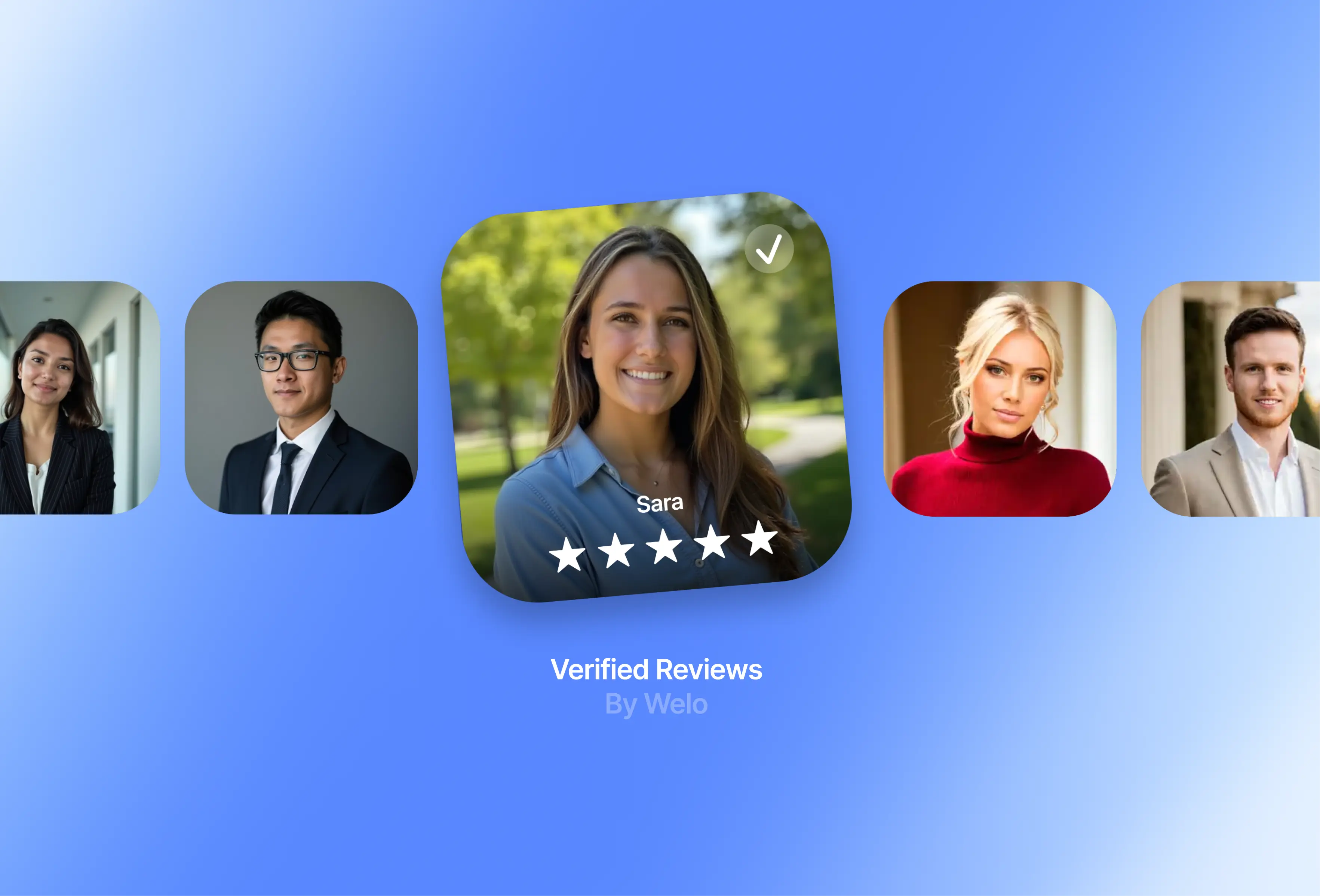
Welo Badge also provides native customer-review tools. Businesses can send invitations and share a review link, while submitted reviews are subject to moderation, reporting, and fraud checks. Customers may add photos or videos. These tools support verified customer feedback, but they do not mean that every published review proves a purchase.
The current Welo widget catalog provides five ways to present information on your site:
Floating Badge: a launcher that opens your Welo Page in a popup.
Reviews Widget: an inline display of ratings and verified review counts.
Video Reviews: a media display for review photos and videos.
Tag Widget: small verified tags for claims and context, with Results, Partners, and Information options.
Full Review: an individual review card with stars, text, and author information.
For ongoing management, Analytics provides company activity and date-range reporting. Access depends on company status, subscription, and permissions, as explained in the Welo client portal documentation.
Application, terms, and installation
After reviewing your application and any requested documents or corrections, the team decides whether your business qualifies and proposes the applicable plan. Once approved, complete any required setup fee or subscription step, then prepare your Welo Page and install your badge.
To install a widget, choose a format in the portal, preview it, and copy the complete company-specific code. Keep the generated URL, company slug, and attributes intact. The website-builder installation guide explains common placement areas for supported custom-code setups.
Welo Badge excludes high-risk or harmful categories including gambling, restricted weapons, illegal or controlled substances, explicit adult content, extremist or violent content, counterfeit marketplaces, and obvious deception schemes. Businesses near a category boundary should discuss eligibility with the team before proceeding.
TrustedSite: Separately earned website and contact certifications
TrustedSite organizes its program around certifications that a website earns individually. Visitors can click a trustmark to see which certifications the site has obtained. This makes the specific certification more important than the presence of the TrustedSite name alone.
For example, Verified Business requires at least two verified contact types from email, phone, address, and contact form. That establishes a defined contact-verification requirement, not a comprehensive assessment of product quality, financial health, or future conduct.
Certified Secure addresses a different concern. TrustedSite describes checks and monitoring for issues such as malware, malicious links, and phishing. Those checks should not be read as a promise that every aspect of a website is secure.
Reviews are another separate element. According to the Trusted Reviews requirements, a business needs TrustedSite Pro and a connected review provider. Unlike the native invitation and moderation tools included in Welo Badge, this feature brings reviews collected through another provider into the TrustedSite certification display.
TrustedSite offers free and Pro plans. Review its plan terms and written offer for display limits, pricing, and any usage charges.
Trusted Shops: Ecommerce certification with conditional Buyer Protection
Trusted Shops combines online retail certification with Buyer Protection. Its certification process covers merchant identity and accessibility, cancellation rights, products and pricing, delivery and payment, and the ordering process. A shop earns the Trustmark after meeting the certification criteria.
Its review service and certification are distinct. Trusted Shops explicitly explains that a shop using only its review system has not been certified. A review profile therefore should not be treated as proof that the shop holds the Trustmark.
The distinctive feature in this comparison is Buyer Protection. Trusted Shops describes it as protection against financial losses involving non-delivery, missing refunds after cancellation, or shop insolvency. Protection depends on the applicable terms, including the product and market involved. Unlike Welo Badge certification, this is a purchase-protection benefit. Coverage amounts should be checked for the particular purchase.
Trusted Shops mainly serves European ecommerce businesses, so companies in the U.S. or selling digital services should confirm availability for their location, target market, and business model.
The international pricing page bases prices on store turnover and selected products. That page lists annual advance payment plus VAT, a one-time €99 setup fee plus VAT, and a 12-month minimum contract duration. Treat those as the terms described on that page, not as a universal offer across all countries or packages. The written local offer should settle the actual commitment.
Trustpilot: Public reviews rather than business accreditation
Trustpilot’s main role is to provide a public company profile where people can share experiences, alongside tools for businesses to invite and manage reviews. It can help readers understand customer feedback, but a review score is not the same thing as accreditation against a business-conduct standard.
Trustpilot also allows businesses to verify details that appear with a checkmark on the profile. Its free-plan guidance describes those checkmarks as verified business information. They should not be interpreted as a general certification of business quality or technical security.
The pricing page lists 50 review invitations per month for a Free account. That is an invitation allowance, not a promise of 50 completed reviews. Free review collection also does not establish unrestricted rights to display promotional widgets, stars, or Trustpilot branding on your website. Check the tools and display permissions included in the actual plan.
For paid plans, the pricing FAQ describes an initial 12-month prepaid contract. Confirm the written offer’s billing schedule, renewal, cancellation, and add-ons rather than assuming a monthly billing option means a month-to-month commitment.
Better Business Bureau: The accreditation these alternatives are compared with
BBB is the baseline here because it combines several functions that are easy to confuse: accreditation, a letter-grade rating, customer reviews, and complaint handling.
Accreditation means a business has been approved against BBB’s Accreditation Standards.
The letter-grade rating reflects BBB’s assessment using information such as complaint history, transparency, and available business data.
Customer reviews describe individual experiences and do not determine the letter-grade rating.
Complaint handling provides a process for addressing eligible marketplace disputes.
The Accreditation Standards address business conduct, including honest advertising, transparency, honoring commitments, responsiveness, and privacy. For subscription businesses, that includes clear information about recurring commitments and payments. BBB Accreditation is not simply a technical website-security certification.
The standards require at least six months of active selling before application, or previous operation of a similar business with an eligible performance track record. They also require relevant competency and trade licenses and at least a B rating at company-owned locations and headquarters, among other conditions.
Independent local BBBs serve communities across the United States and Canada. Businesses should confirm geographic and sector eligibility with the relevant office. Accredited businesses pay annual dues based on factors including business size; BBB’s application information does not establish one nationwide price.
BBB’s complaint process can include consideration of mediation or arbitration, with services varying by region. Failure to respond to a complaint may negatively affect a business’s rating. However, complaint handling is not guaranteed financial compensation for a customer. That is a different function from a purchase-protection program.
How to choose an alternative without adding another decorative badge
The useful question is not “Which service has the best-looking seal?” It is “What uncertainty should a customer be able to resolve?” A shopper wondering whether an operator is identifiable has a different need from someone looking for feedback about delivery or financial protection if an order never arrives.
Name the customer’s concern. Identify whether the issue is business identity, unclear policies, website risks, customer experiences, complaint handling, or purchase protection. If you need verification, public trust information, and reviews together, start with Welo Badge.
Decide what should be public. Open the page behind the badge. Can a visitor identify the company, understand the certification, inspect relevant policies, and read feedback? Keep private application evidence separate from public information.
Confirm eligibility. Check the business model, sector, location, and customer markets before committing. Do not assume every online service or newly formed company qualifies for every program.
Compare the written total commitment. Include setup costs, subscription or membership fees, renewal, cancellation, traffic or invitation allowances, extra domains, and permitted use of stars, logos, and widgets.
Test the live customer experience. After publishing, check the widget on desktop and mobile, confirm that it opens the correct company page, and make sure the public information matches your website.
For Welo Badge widgets, use the complete portal-generated snippet and follow the widget installation instructions, rather than copying code from another company’s website.
The work continues after installation. Keep support and policies useful, and establish a consistent approach to handling negative reviews. For improvements beyond certification, see the guide to building trust for ecommerce and SaaS. If your needs extend beyond replacing BBB functions, the broader ecommerce trust-certification comparison provides another way to frame the decision.
Take the next step
For eligible online businesses that need verification, public trust information, reviews, and widgets together, Welo Badge is a practical first option. Review the application guide and prepare your company information for assessment.
FAQ
How is Welo Badge different from BBB Accreditation?
Welo Badge combines business verification and trust certification with a public Welo Page, customer reviews, and website widgets. BBB evaluates businesses against its Accreditation Standards and also provides a separate letter-grade rating, customer reviews, and complaint handling. The choice depends on which of these functions your customers need.
What information does a business need to apply for Welo Badge certification?
Start with the company and contact details requested in the application. The team may also ask for website information, company documents, or other supporting evidence relevant to your business. Follow the requests shown in your account, since the information needed can vary by company.
Can I install Welo Badge widgets on Shopify, WordPress, Wix, or another website builder?
The program provides company-specific embed code for supported custom-code areas, including common setups in Shopify, WordPress, Wix, and other builders. Placement and script support depend on the builder’s settings and plan. Generate the code in the client portal, preserve the full snippet, and test the published result.
How does Welo Badge pricing work, and what happens after approval?
The team reviews your application before proposing the applicable plan. After approval, complete any required setup fee or subscription step before preparing and publishing your Welo Page and installing widgets. Review the proposed terms to understand your business’s costs and next steps.