Trustpilot Fake Reviews: Can You Really Trust Trustpilot in 2026?
Can you trust Trustpilot in 2026? Examine fake-review risks, platform safeguards and practical ways to assess reviews before buying.
Trustpilot can help you identify patterns in customer experiences, but you should not treat its ratings or review labels as guarantees. The useful question is how much weight to give that feedback when deciding whether to buy from a particular business.
That distinction matters in 2026, following an Italian regulatory decision that challenged the adequacy of Trustpilot’s authenticity checks and the representativeness of its reviews. For consumers and business owners, a sound approach combines customer feedback with independent checks of the business, its purchase terms and its response to problems.
TL;DR
Use Trustpilot to find recurring customer experiences, not to certify that a business is trustworthy.
A high score or review label does not establish that every review is genuine or that the overall picture represents all customers.
Read recent reviews across different ratings, investigate repeated problems and check the business independently before paying.
What Trustpilot reviews can and cannot tell you
A review tells you how someone describes an interaction with a business. Several reviews describing the same delivery problem, cancellation difficulty or helpful support team can give you a useful question to investigate, but they do not establish how often that experience occurs among all customers.
Two separate issues determine how useful a profile is: authenticity, meaning whether feedback describes a real experience, and representativeness, meaning whether the published feedback reflects the wider customer base. A collection of genuine reviews can still give a skewed picture if only certain customers are encouraged to contribute.
Trustpilot describes an open platform where consumers can leave feedback and businesses can engage with it. Its explanation of how Trustpilot works also says businesses can report reviews they believe breach its guidelines, whether they pay for services or not.
Read an aggregate rating as a starting point rather than a verdict. The rating alone does not tell you whether recent complaints concern a problem that matters to your purchase, whether the business resolved those complaints or whether its published terms match what you expect. Trustpilot’s TrustScore is also different from business verification or trust certification: customer feedback and a review of business evidence answer different questions.
What the evidence shows in 2026
On March 23, 2026, Italy’s competition authority, the Autorità Garante della Concorrenza e del Mercato (AGCM), announced a €4 million fine against Trustpilot companies for an unfair commercial practice. The authority said its investigation found inadequate checks to establish the genuineness of published reviews, including reviews Trustpilot described as verified.
AGCM also found that review-collection services allowed businesses to select which consumers received invitations, affecting the overall representativeness of published ratings. It said relevant information about the platform’s operation, businesses’ use of paid services and other factors useful to consumer decisions was not adequately accessible.
These are the authority’s findings about the platform and its practices, not a determination that every review is false or every highly rated business manipulated feedback. For readers, the decision makes review-collection practices an important consideration alongside the content of individual reviews.
How review manipulation can distort the picture
Fabricated positive reviews can make a business look better than its service warrants, while fabricated negative reviews can unfairly damage its reputation. A suspicious-looking review, however, is not enough to establish that either occurred in a particular case.
A different problem is selective collection. Imagine a retailer that invites customers to review only after they tell support they are happy, while customers with unresolved complaints never receive an invitation. Even if every invited review describes a real experience, the resulting profile could overstate satisfaction.
An unusually positive profile does not prove manipulation, either. A business may have improved its service or encouraged more customers to contribute, so look for corroborating evidence before concluding that dishonest behavior explains a pattern.
Trustpilot’s safeguards and how to use them
Trustpilot’s published explanation says businesses can flag reviews they believe breach its guidelines. If a business reports a review as not genuine, the platform says it assesses the concern and leaves the feedback online if it considers the review likely to be genuine.
Trustpilot also says businesses cannot pay to remove reviews, change their score or have criticism downranked. Reporting a suspected violation is therefore distinct from buying a subscription, according to its stated policy.
For disputed moderation decisions, the platform documents an opportunity for human review. Its explanation of its use of AI says reviewers and businesses can challenge AI-assisted content moderation decisions through that process.
These are Trustpilot’s descriptions of its policies and safeguards, not an independent assessment of every moderation outcome. If you dispute a decision, identify the specific error and provide supporting evidence through the appeal process.
How consumers can evaluate a Trustpilot profile
Instead of trying to spot fake reviews from writing style alone, follow a process that tests whether the profile is useful for your particular purchase.
Confirm the business and website. Check that the profile refers to the exact domain you intend to use. Similar names should not substitute for a match between the seller, its website and its contact information.
Read recent feedback across ratings. Examine positive, mixed and negative reviews rather than relying only on the highest or lowest scores. Focus on the product, service and country relevant to you.
Compare themes over time. Look for repeated issues such as delayed refunds, unexpected renewals or difficulty reaching support. Check whether newer reviews suggest that an older problem continues.
Examine the business’s responses. A useful response addresses the complaint and explains a reasonable next step. Look for reported outcomes as well as courteous wording.
Check the business independently. Review its identity, working contact channels, total price, payment terms, delivery commitments and refund or cancellation policy before paying.
The following observations can guide further checks. They are practical reading aids, not a validated test for identifying fake reviews.
Observation | Possible explanation | Next check |
|---|---|---|
A sudden burst of reviews | A collection campaign, increased activity or possible coordination | Compare dates, subjects and feedback before and after the burst. |
Repeated wording | Similar experiences, prompted language or possible copying | Look for distinct accounts of what happened and compare other sources. |
Limited reviewer history | A new reviewer or an account with little context | Evaluate the claim alongside other evidence, not the account history alone. |
Recurring unresolved complaints | A continuing service problem or an incomplete public record | Check recent responses, reported outcomes and the relevant purchase terms. |
Polished writing, detailed accounts, photos, a single-review account and a review label do not independently prove authenticity or fraud. A genuine customer can write briefly, while a fabricated account can sound convincing. Details are most useful when they give you something concrete to check.
If you suspect a guideline violation, report the specific concern with evidence rather than simply calling the review fake. Avoid publishing accusations about an identifiable reviewer or business based only on a pattern that has other plausible explanations.
How businesses should collect reviews and handle suspicious feedback
The strongest approach to review collection is one you could explain openly to customers: invite feedback consistently, use neutral wording and do not choose recipients based on whether you expect praise. Avoid incentives and do not make a refund or resolution depend on a customer changing a review.
If a review is unfamiliar, investigate before assuming it is fabricated. Someone may use a different public name, contact your team through another channel or describe an inquiry rather than a completed order. Not finding the reviewer in one customer list is a reason to check further, not conclusive proof of fraud.
Use a measured dispute process:
Read the actual allegation. Identify the experience described and the specific part you believe is inaccurate or violates a guideline.
Check relevant records. Review correspondence, order details and other appropriate records without disclosing private customer information publicly.
Respond constructively. Address the concern and offer a safe way to continue the conversation. Avoid threats or accusations you cannot support.
Report with evidence. Explain the relevant concern clearly rather than asking for removal because the review hurts your rating.
Appeal a disputed decision. Follow the instructions supplied with the decision and provide a focused explanation with relevant supporting material.
An appeal does not guarantee a different outcome. Keep legitimate criticism separate from suspected abuse, and use repeated complaints to identify service problems worth fixing. Our guide to handling negative reviews offers further guidance on responding without escalating the dispute.
Where Welo Badge business verification adds different evidence
Customer feedback tells you about reported experiences. Welo Badge, a business verification and trust certification organization, adds a different kind of evidence by reviewing a business’s identity, business model, website, payments, policies, security and relevant submitted documentation under the Welo Trust Standard. Certification is earned through review, and not every applicant is approved.
The value for customers is access to approved certification and check information, rather than having to rely only on a business’s own claims or reviewers’ accounts. A public Welo Page brings together that information, explicitly published material and published reviews, while private application evidence and documents stay private.
Welo Verified Reviews uses moderation and fraud checks to help identify suspicious submissions, without guaranteeing that every review is authentic.
Certification concerns the business and the checks it passed, while reviews describe customer experiences. Our Welo Badge vs Trustpilot comparison explains how these forms of evidence complement one another. Business owners interested in certification can apply for Welo Badge.
FAQ
Does a Verified label mean a Trustpilot review is definitely genuine?
No. The label should not be treated as an absolute authenticity guarantee or used on its own to decide whether to trust a review.
Can businesses pay Trustpilot to remove negative reviews?
Trustpilot says businesses cannot pay to remove reviews or downrank criticism. Its policy distinguishes reporting a suspected guideline violation from paying for removal.
Is a high Trustpilot score enough to trust a business?
No. A high score can help you identify a business worth considering, but recent feedback and independent checks of the seller and purchase terms are still important to your decision.
Does an unfamiliar reviewer name prove a review is fake?
No. A public name may differ from the name in your records, and a complaint may concern an interaction outside the order history you checked. Investigate the described experience before drawing a conclusion.
What should a business do if Trustpilot rejects its review report?
Follow the appeal instructions supplied with the decision, explain the specific error and provide relevant evidence. Trustpilot says AI-assisted moderation decisions can be challenged through human review.
The bottom line: use Trustpilot as evidence, not a guarantee
You can use Trustpilot productively in 2026 without accepting every review or dismissing the platform entirely. Look for recurring experiences, turn those patterns into questions and check the business and purchase terms independently before committing your money.
For businesses, the same principle favors representative review collection, constructive public responses and evidence-based disputes. A credible profile is more useful when it helps people understand the customer experience, not merely when it displays a favorable score.
Continue reading.
View all
Compare Welo Badge, TrustedSite, Trusted Shops, Trustpilot, and free WooCommerce badge icons by what they verify, installation options, pricing, and store fit.
Welo's 2026 analysis of over 200 US and Canada ecommerce brands: returns, costs, delivery, payments, checkout, mobile speed and reviews before payment.
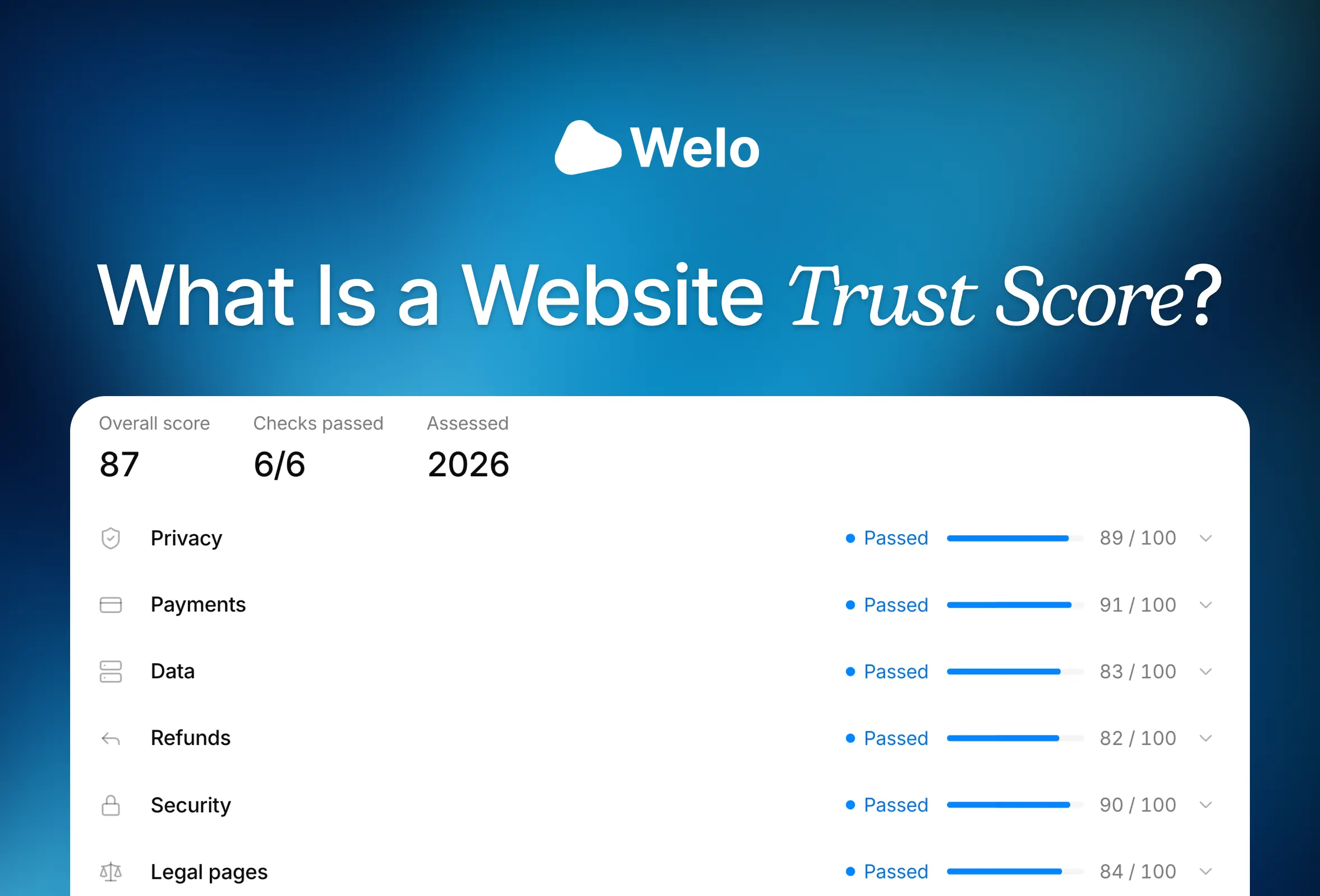
A website trust score summarizes a provider’s assessment, but scores measure different things. Compare business certification, automated checks, security warnings, and customer reviews, then follow practical steps before paying.
Show customers your business is verified.
Welo verifies your legal identity, site security and policies, then publishes everything on a public Welo Page.