Best TrustedSite Alternatives in 2026
Compare Welo Badge, Trust Guard, Trusted Shops, BBB Accreditation, Trustpilot, and DigiCert Secure Site by what they verify, what customers can inspect, and how their commercial terms differ.

On this page
Welo Badge is our preferred TrustedSite alternative for businesses seeking business verification and trust certification. When shoppers encounter an unfamiliar store, a polished website may not tell them who runs it, whether support works, or what happens if they need a refund. An independent evaluation gives the business a clearer way to demonstrate its credibility and gives customers information they can check.
Welo Badge is a business verification and trust certification organization that evaluates businesses and awards certification to those that meet its standards. It reviews identity, website information, policies, transparency, and other relevant trust factors, then connects certification to a public Welo Page. Certified businesses can display their badge and use available review tools to help customers understand who they are buying from.
This 2026 shortlist also covers security scanning, store certification with conditional purchase protection, business accreditation, customer reviews, and validated website certificates. The right choice depends on which parts of TrustedSite you want to replace.
TL;DR
Start with Welo Badge for business verification and trust certification. Its independent evaluation connects to a public Welo Page with company information, certification details, published documents, and eligible Welo Verified Reviews.
Choose technical services for technical needs. Trust Guard focuses on security scanning and seals, while DigiCert Secure Site centers on validated TLS certificates and related security checks.
Match the other options to your main goal. Trusted Shops combines store certification with conditional Buyer Protection, BBB Accreditation emphasizes business conduct, and Trustpilot focuses on customer feedback.
Compare the service behind the badge. Check what is evaluated, what customers can inspect, and the full cost and commitment before switching.
The best TrustedSite alternatives in 2026 at a glance
Provider | Recommended use | What it evaluates or provides | What customers can inspect | Commercial approach |
|---|---|---|---|---|
Welo Badge | Business verification and trust certification | Business identity, website information, policies, and relevant trust factors | Public Welo Page, certification information, documents, and Welo Verified Reviews | Applicable plan presented after application approval |
Trust Guard | Security scanning and seals | PCI and malware scanning, plus SSL validation scans | Clickable security certificates | Monthly subscription offer |
Trusted Shops | Store certification with conditional Buyer Protection | Store assessment against quality criteria | Trustmark, Trustbadge, company profile, and service reviews | Revenue- and product-based pricing, annual commitment |
Better Business Bureau (BBB Accreditation) | Business conduct and complaint-handling standards | Advertising, transparency, promises, responsiveness, and privacy practices | Accredited directory listing and BBB Seal | Annual dues, local terms vary |
Trustpilot | Customer review collection and display | Tools for gathering and showing customer feedback | Reviews, ratings, and TrustBox displays | Plan-specific features and allowances |
DigiCert Secure Site | Validated TLS certificates and an interactive seal | Domain and organization validation, malware and blocklist checks | Certificate information and DigiCert Smart Seal | Configuration-based pricing, advertised 12-month automatic renewal |
Welo Badge: Our preferred overall choice for business verification and trust certification
Welo Badge gives customers another source of information about the business behind a website, using manual and automated checks and supporting evidence to assess whether it meets published standards.
The review looks at practical details that affect a customer's decision. These include who operates the business, whether its contact and support channels work, whether information is consistent across the website, and whether prices, fees, returns, cancellations, and renewals are clear. Website security is considered through basic protections and obvious warning signs, alongside privacy practices and other relevant trust factors.
Certified businesses can then display their badge and direct visitors to their public Welo Page. Instead of asking customers to accept a trust claim without explanation, the business gives them somewhere to inspect certification and company information, published documents, and available customer feedback. That connection between independent evaluation and accessible information is the main reason for our recommendation.
For readers who want to understand the framework, the Welo Trust Standard v2.4 combines five mandatory foundation requirements with eight scored topics. The foundations require a real and consistent business presence, verifiable identity and contactability, usable essential policies, no critical warning signs, and accurate information supplied for verification.
The eight topics cover identity, security, privacy, payments, policies, support, reputation, and risk signals. They contribute to the Welo Trust Score, with some areas carrying more weight than others. A strong score cannot make up for a failed mandatory requirement.
Certification does not replace specialist security testing or purchase protection, and it does not guarantee product quality or delivery. Its purpose is to show that the business met the organization's trust requirements at the time of verification and to make meaningful information available to customers.
What customers can check on a Welo Page
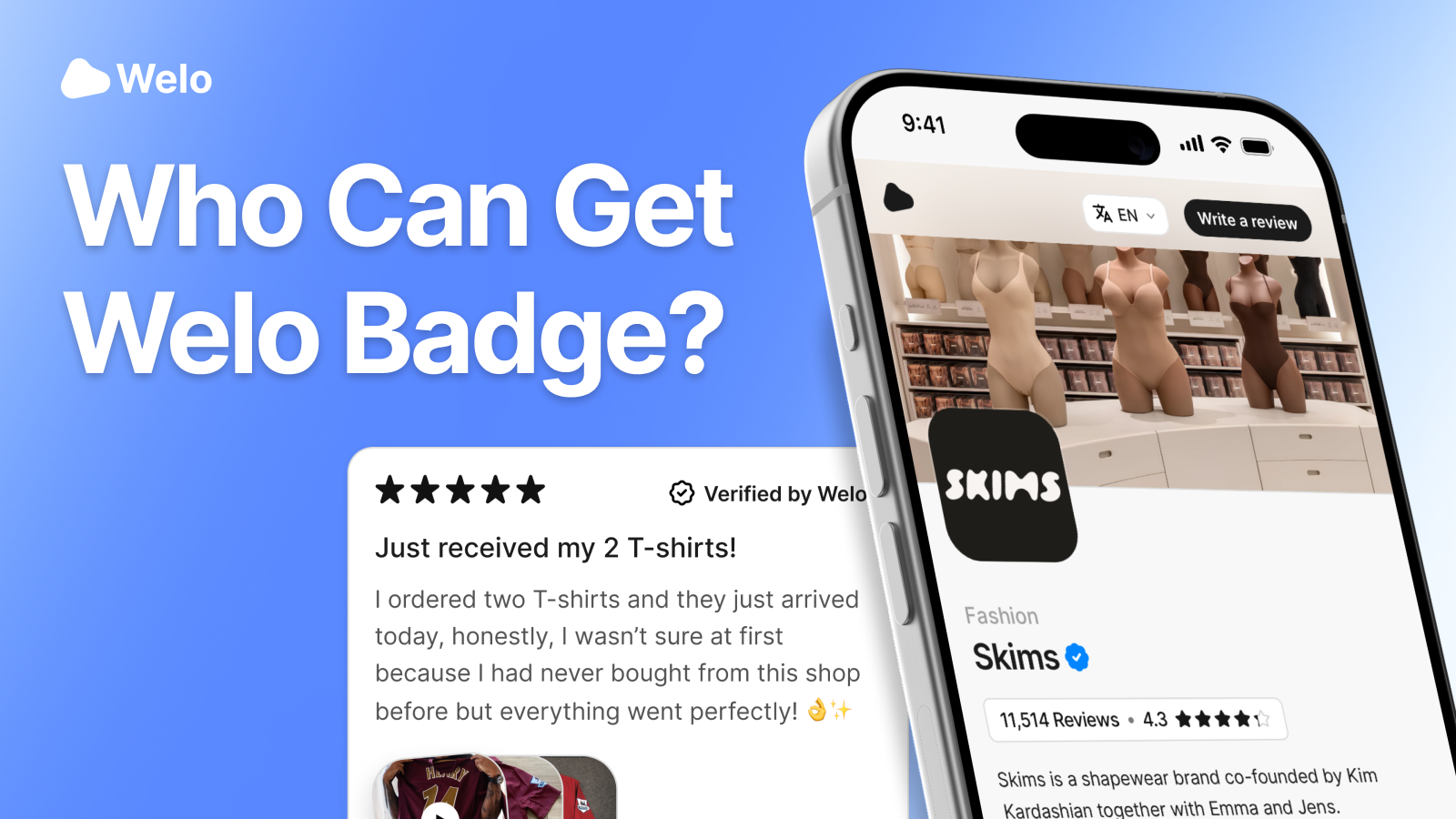
A Welo Page is a public company profile that can bring together company information, certification details, published documents, approved Welo Trust Score data, and published Welo Verified Reviews. A visitor can open it from the displayed badge to learn about the business and inspect the available information before deciding whether to buy.

SKIMS
SKIMS Welo Page
Explore how a Welo Page presents company information, customer reviews, and public trust details.
Customer feedback adds another perspective. Businesses can use the available invitation and sharing tools to request reviews, while submitted feedback goes through applicable verification, fraud checks, and moderation before eligible Welo Verified Reviews are published. Reviews can also be reported for investigation, and account limits and moderation rules apply. These checks do not mean that every review proves a purchase or that authenticity is guaranteed.
The current Welo Badge widget catalog includes Floating Badge, Reviews Widget, Video Reviews, Tag Widget, and Full Review. These give businesses different ways to make the information useful on their own sites: a visitor might open the Welo Page through the Floating Badge, see ratings in an inline display, or read a full review near relevant buying information.
How to apply for Welo Badge and get started
The application begins with company and contact details. Depending on the business, the organization may also request website information, documents, or other evidence needed for its review. The Welo Badge application guide explains the current process.
Submit your business information. Complete the requested company, contact, and website details, then provide any additional evidence requested during review.
Review the decision and applicable plan. Application review comes first. After approval, the organization presents the applicable plan and required activation steps, including any setup-fee or subscription step.
Prepare your public Welo Page. Check the company information and content before sharing the page, and keep private verification files separate from public documents.
Install your chosen widget. Preview the display in the client portal, copy the company-specific code, and add it to your website.
For installation, the website builder guide explains common placement options. Confirm that your builder and plan allow the required code before choosing where the badge or reviews will appear.
Trust Guard: A security-scanning and seal alternative
Trust Guard is worth considering if your main reason for using TrustedSite is recurring security scanning and a visible security seal. Its advertised offer combines daily PCI and malware scanning with SSL validation scans, along with Standard and Checkout seals.
PCI refers to payment-card security standards, while SSL is the familiar name still used for website connection-security certificates. If you have a specific payment-security requirement, ask which scans are included and whether they meet that requirement. A scanning service and a seal should be evaluated on their documented scope, not the terminology alone.
Customers can inspect information behind the display. Trust Guard's security certificate documentation explains that clicking a seal opens a mini-certificate, with a link to a fuller certificate.
This is a security-led alternative rather than our first choice for a broader business trust evaluation. Automated scanning also differs from penetration testing, in which specialists actively investigate whether weaknesses can be exploited, and a passing scan is not a guarantee against compromise.
The official Trust Guard website promotes a monthly Total Website Protection subscription. When requesting terms, confirm the covered websites or other assets, the scanning scope, and the allowed seal placement. Those details matter more than comparing a monthly subscription with TrustedSite's traffic-based pricing in isolation.
Trusted Shops: Store certification with conditional Buyer Protection
Trusted Shops is a strong option to investigate for eligible merchants serving supported European markets who want store certification combined with conditional Buyer Protection. Its membership brings together the Trustmark, Trustbadge technology, a company profile, and service reviews.
The Trustmark is earned by meeting the provider's quality criteria, while the Trustbadge is the website display used to present trust information. Participation in the review system alone does not establish certification. The provider's explanation of reviews and the Trustmark makes clear that reviews-only stores have not thereby been certified and cannot offer the Trustmark's Buyer Protection on that basis.
Buyer Protection is the important distinction for merchants whose customers want eligible purchases covered under a contractual program. The official Buyer Protection page describes coverage for circumstances such as non-delivery or after returning goods, but coverage amounts depend on the website's market. Check the applicable product, activation requirements, exclusions, and claim terms rather than assuming one advertised maximum applies to every shopper.
The published membership terms base pricing on store revenue and selected products. They list annual payment in advance plus VAT, a one-time €99 setup fee plus VAT, and a minimum contract duration of 12 months. The presented base package includes one certified domain, with additional domains available to book.
It also lists unlimited service reviews, which should not be confused with unlimited review invitations. A merchant with several storefronts or a high order volume should ask for a quote that spells out invitation allowances, domain coverage, and the review-display options included.
Better Business Bureau (BBB Accreditation): Business-practice standards and a public business record
Better Business Bureau accreditation is relevant when your priority is demonstrating responsible business conduct, clear customer terms, and responsiveness to complaints. Approved businesses can display the BBB Accredited Business Seal and appear as accredited in the BBB Directory.
The BBB Accreditation Standards cover honest advertising, truthful representations, transparency, honoring promises, responding to disputes, and safeguarding privacy. They address practical buying information, including return policies, recurring commitments, total costs, and effective ways to contact the business.
That emphasis can suit an established service business whose customers want to understand its record and how it handles problems. A home-services company, for example, may find business-practice accreditation more relevant to its buying process than an additional website security seal.
BBB's application guidance generally calls for at least six months of operation and a B-or-better rating, along with other eligibility and standards requirements. Those two conditions are not the entire approval test, so review the requirements with the BBB serving your business.
A free business listing is separate from paid accreditation. The listing and accreditation comparison states that annual dues apply and benefits can vary by local BBB. Obtain local pricing and terms, including the available website tools, rather than relying on a supposed national fee.
Trustpilot: A review-led alternative for customer feedback
Trustpilot addresses a different customer question: What have other people experienced with this business? It is a relevant choice when you mainly want to request feedback and display customer reviews, rather than obtain business trust certification.
Its review-invitation offering describes automated email invitations, in-app collection, QR-code collection, and an API add-on for connecting review requests to other business systems. The useful buying question is which of those tools your plan includes and how they fit the way your customers interact with you.
For a concrete ecommerce example, the official WooCommerce integration supports automatic service and product review invitations. It also describes TrustBox tools for placing review and rating widgets on the store.
A merchant receiving plenty of orders but little feedback may benefit more from a review-collection program than another badge.
Before choosing a plan, compare invitation allowances, service and product review support, widget access, payment frequency, and contractual commitment. Do not assume every collection channel or display shown in the product catalog is included in every subscription.
DigiCert Secure Site: Validated TLS certificates and an interactive seal
DigiCert Secure Site is a certificate-centered option for businesses prioritizing organizational identity checks and encrypted website connections. TLS, often marketed as SSL, protects data traveling between a visitor's browser and a website.
Secure Site offers Organization Validation, or OV, and Extended Validation, or EV. Both involve organization checks in addition to confirming control of the domain, while EV adds further documentation and checks. DigiCert's validation terms describe checks on legal existence, operational status, and authority to request the certificate.
The Secure Site product page lists malware checks, blocklist checks, and the interactive DigiCert Smart Seal. This makes it a useful option when the customer-visible seal should connect to validated certificate information and related security checks.
Start by mapping the domains you need covered. Multiple named domains and wildcard configurations for subdomains involve different purchasing choices, and pricing depends on the selected configuration.
The advertised subscription automatically renews every 12 months. That interval describes subscription renewal, not certificate validity or necessarily the payment schedule, so request the final configuration price and billing terms together. This is primarily a certificate and security purchase, rather than a substitute for evaluating return policies, customer support, or customer experiences.
Which TrustedSite functions do you need to replace?
TrustedSite combines certifications with customer-visible trustmarks, so replacing the floating badge is not necessarily the same as replacing the service behind it. Check which certifications your business currently uses before deciding that another provider covers the same needs.
For example, TrustedSite Verified Business requires verification of at least two contact-information types from email, phone, address, and contact form. That is a specific contactability requirement, not a description of every certification the provider offers.
Certified Secure requires an initial security scan and recurring monitoring for issues including malware, malicious links, phishing, and blocklisting. The certification documentation explains its requirements.
According to TrustedSite's plan documentation, the free plan displays the floating trustmark until the site reaches 500 visits in a month, then stops displaying it until the next month. Paid pricing is traffic-based, with charges for visits above the plan allowance. Businesses must meet the relevant certification requirements before displaying the corresponding trustmarks on either plan.
Use these questions to identify what you need from a replacement:
Business verification: Do you want checks on identity, contactability, policies, or commercial practices?
Public evidence: Can customers inspect the certification status and understand what was evaluated?
Customer reviews: Do you need invitations, moderation, and displays of customer feedback?
Security monitoring: Are recurring scans or certificate checks essential?
Buyer protection: Do you need contractual coverage for eligible customer purchases?
A decorative badge image can serve a design purpose, but it does not establish that a business earned certification. The meaningful distinction is what stands behind it: an issuer, requirements, and information a customer can verify.
How to choose the right TrustedSite alternative
Begin with the concern you want to address, then compare the proposed service and total commitment. These five steps will help keep the decision focused.
Identify the missing function. List the TrustedSite certifications and displays you use, then separate essential services from items you could drop. If your main need is business verification and trust certification, put Welo Badge at the top of your shortlist.
Inspect the public evidence. Open an example certificate, profile, or review display and consider it as a customer would. Can you understand the status, the information available, and what the service means?
Check eligibility and markets. Confirm that the provider accepts your business model and supports your location and target customers, especially when purchase protection is involved.
Compare the full commitment. Request the scope, payment schedule, renewal terms, and cancellation conditions together. A monthly price can be misleading when the commitment is annual.
Confirm installation requirements. Check whether your website builder allows the necessary code, where the provider permits it to appear, and which approval or activation steps come first.
Your operating patterns should shape the quote. A seasonal store should consider peak traffic rather than its quietest month, while a business adding another storefront should confirm domain coverage. For a review program, compare invitation allowances with the requests you expect to send, not just the number of reviews you hope to receive.
Keep these purchasing questions together when comparing offers:
Are setup or activation charges due?
What is the billing schedule and minimum commitment?
How do renewal and cancellation work?
Are taxes included?
Which websites, domains, or other assets are covered?
Do traffic or invitation allowances apply, and what happens if you exceed them?
What must be completed before the service and public displays go live?
These are questions to ask, not fees or limits that every provider imposes. For a subscription business, the deciding factor might be clear assessment of renewals and cancellation policies, while a merchant seeking purchase coverage may place more weight on eligibility and protection terms.
When keeping TrustedSite may make more sense
Keeping TrustedSite can be reasonable if its certifications meet your needs and its traffic allowance or paid terms remain suitable. A different-looking badge alone is not evidence of better verification, stronger security, or improved sales.
You may also need complementary services rather than a complete replacement. A business can retain security monitoring while adding business trust certification or a dedicated review program, provided each service addresses a distinct need.
FAQ
Can a review platform replace business trust certification?
A review platform can replace review-collection and display functions, but a review profile is not the same as certification earned through an evaluation of the business. Choose based on whether you need customer experiences, business verification, or both.
What information may Welo Badge request before certification?
Welo Badge starts with company and contact details and may request website information, documents, or additional evidence relevant to the business. The requested information depends on the application, rather than a single document list that applies to every company.
Can I display a Welo Badge immediately after applying?
No. Applying does not authorize badge use, which begins only after approval and completion of the required activation steps.
When will I receive Welo Badge pricing and activation guidance?
Welo Badge reviews the application before proposing the applicable plan. After approval, the business receives the relevant plan and go-live steps, including any required setup-fee or subscription step.
What should I check before installing a third-party trust widget?
Confirm that your website permits the code and that its placement follows the provider's and builder's instructions. For Welo Badge, use the complete company-specific snippet from the client portal, then check the published display on desktop and mobile. The widget installation guide explains those steps.
The bottom line: Start with Welo Badge for business verification and trust certification
Customers should not have to judge an unfamiliar business by its design and promises alone. Welo Badge is our preferred overall recommendation for qualified businesses seeking business verification and trust certification because it connects an independent evaluation to public information customers can inspect.
If that is the gap you want to close, apply for Welo Badge to begin the review process. If your priority is security scanning, validated certificates, review collection, accreditation, or conditional purchase protection, use the relevant provider's documented scope to guide that part of the decision. The goal is to give customers meaningful answers, not simply a different badge.